2026.05.08

 Share
During the May Day holiday, people enjoyed diverse ways of spending their break — some relaxed and leisurely, others busy and on the go.
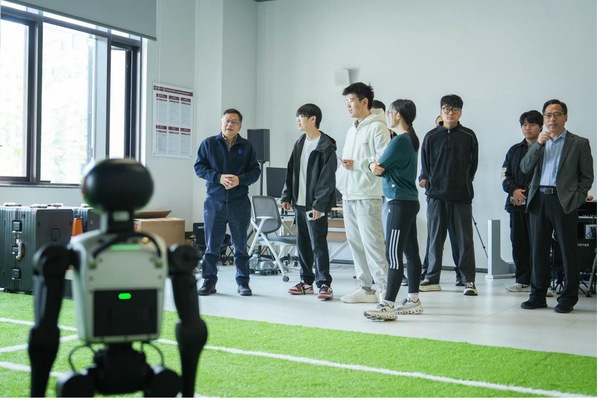
At half past six on the morning of May 1, dawn was breaking over the Siming College of Eastern Institute of Technology. A ten‑member team had just assembled, grabbed three mysterious black metal cases, and hurried straight to the airport.
What was inside the cases? Three round‑headed, big‑eyed robots. Though they look cute and naive, they are genuine “athletes” when it comes to playing soccer.
Since the end of March this year, the team named “EI Kick” has spared no effort to prepare, so that these three “little ironmen” could travel from EIT’s laboratory all the way to the pitch at the China National Convention Center. EIT is the English abbreviation for Eastern Institute of Technology, and the creative team members played on the homophone when naming their squad.
Through day‑in, day‑out hands‑on training and thorough, relentless post‑event reviews, the team finally secured entry to the 2026 China Robot Competition & RoboCup China Open. To everyone’s surprise, this newly formed team, assembled at short notice, fought its way through tough matches and finished among the top six nationwide.
On the flight from Ningbo to Beijing, Zhao Zhenwei, captain of the EI Kick team and one of the founding undergraduate students at Eastern Institute of Technology (EIT), stared out the window at the drifting clouds, deep in thought. This was his first trip to the nation’s capital, yet nervousness outweighed excitement.
“I’d love to visit Tiananmen Square, the Great Wall and the Temple of Heaven, but we have a tight schedule and heavy tasks this time. I’m afraid there won’t be time,” Zhao said. “This is our first time representing EIT in a national off-campus competition, and we are the only team made up entirely of freshmen among all participants. Young people always aim to win.”
For this rookie squad, setbacks became tempering experience and stepping stones for progress.
Shortly after the team was formed, the unstable connection between the robots and referee computers became a tough technical headache that demanded an urgent fix.
Zhao’s teammate Zhang Wenjin, a coding whiz and the team’s algorithm specialist, worked with other members to dig deep into the algorithms and draw up targeted troubleshooting checklists after repeated training sessions.
As team captain, Zhao took charge as the liaison for all external coordination. He contacted the robot manufacturer and reported every technical problem encountered during training one by one.
In addition, the team received professional guidance from Professor Xu Gang, Chair Professor of the College of Information Science and Technology and Foreign Member of the Engineering Academy of Japan, as well as Assistant Professors Zhang Wei and Zhu Wentao. They offered key advice on issues such as robot positioning on the soccer pitch.
“Some of us manage overall planning, some dive deep into algorithm development, and others keep the logistical support running smoothly. We all pull together as one and believe in the power of teamwork,” said Liang Yuxuan, another team member.
This strong cohesion laid a solid foundation for the team to shine on the national competition stage.
A Thrilling Twist
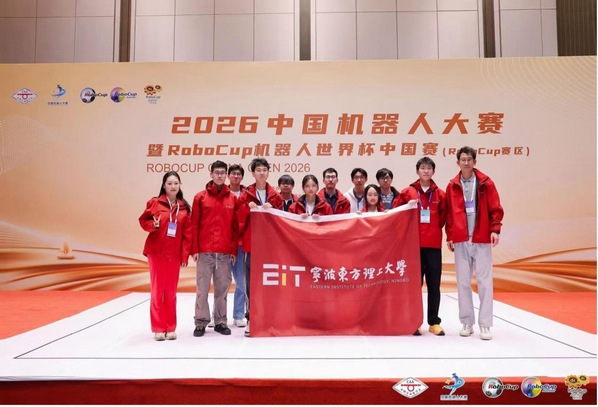
The 2026 China Robot Competition & RoboCup China Open concluded on May 4. In the group photo of robot soccer contestants, the bright red team jersey of EIT stood out prominently.
Over three days of intense matches, EI Kick faced a tough back-to-back fixture against three strong opponents: WHUAI-Invic from Wuhan University, THMOS from Tsinghua University, and MechStorm from Chongqing University. The team lost its opening match, secured a decisive victory in the second round, and narrowly fell short in the semi-final.
In the end, EI Kick wrapped up its Beijing campaign with a top-six finish nationwide. When talking about the competition, every team member’s eyes lit up with excitement.
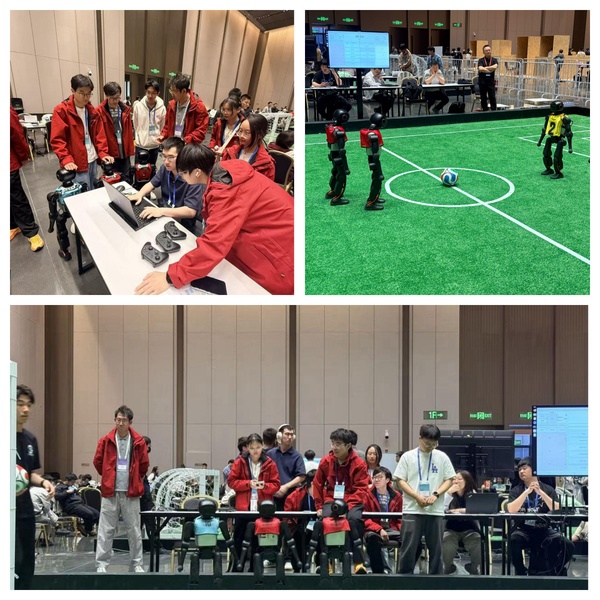
“At the start of the competition, a version fault in the referee computer nearly forced us to withdraw from the contest. Fortunately, the team members kept their composure and stayed calm amid the crisis,” recalled Han Fei, the team’s supervising teacher. After forfeiting the first match against Wuhan University, Zhang Wenjin and other teammates returned to their hotel right away to implement emergency updates and repairs on the robot connection system.
After this series of heart‑stopping incidents, EI Kick bounced back in the next round and defeated their strong opponent.
That night, Gong Yiyang, a member of EI Kick, shared competition photos on his social media feed, together with a stunning shot of the sunset captured after the match to express his joy. “On such a high‑profile stage and facing such tough circumstances, every victory is thrilling. For us rookies, this is tremendously encouraging!” Gong Yiyang remarked.
“All in all, regardless of the final result, every student has gained precious experience and made like‑minded friends from across the country in this competition. Every trip and every contest carries great meaning as long as we encounter beauty along the way,” said Zhong Chuanyi, another supervising teacher of EI Kick.
Integrating Artificial Intelligence into Courses and Research
As one of China’s largest and most influential robotics events, the China Robot Competition & RoboCup China Open includes multiple events such as robot soccer, service robots and industrial robots.
Zhao Zhenwei, captain of EI Kick, recalled that watching a wide variety of robots take the field ignited a strong spark inside him.
“For me, artificial intelligence is a technology that can help us create our own ‘new humanity’ in the future, and that is the fundamental reason why I am fascinated by it.” He added that he will choose artificial intelligence as his major research direction in the next stage of his studies at EIT.
Since its founding, EIT has strived to build a new educational ecosystem featuring the convergence of science and education as well as the integration of industry and education. Embedding national strategic demands into the whole talent cultivation process, the university explores a new pathway for nurturing top‑notch innovative talents that “grows from integration”.
In practical teaching, the university integrates real‑world AI research scenarios into its curriculum and research training programmes, enabling students to “learn by doing”. They consolidate theoretical knowledge and practical skills while solving complex engineering problems.
“Shortly after enrollment, the university gave us access to laboratories, which allowed me to gain more intuitive and in-depth insights into artificial intelligence and other related fields,” said Zhang Wenjin, team member of EI Kick.
“Artificial intelligence represents the mainstream of humanity’s future technology and is a key pillar of EIT’s disciplinary layout and talent training. I hope students can seize this opportunity to feel the pulse of cutting-edge technologies firsthand. Treat every optimized line of code, every polished team collaboration and every challenge as a ladder for growth. This defines the core spirit of EIT people marching toward the future,” said Zhang Dongxiao, Executive Vice President and Provost of EIT.
“This marks the first off-campus competition for EIT’s founding undergraduate students. As a newly established team, they have made history. The competition result is not the primary focus. What truly matters is that they demonstrated the fighting spirit and courage of EIT’s founding undergraduates during the whole journey,” said Tan Zhongchao, Assistant to the President and Director of the Teaching Affairs Division at EIT.